


Best Wry Neck Treatment Options in Melbourne

Waking with your head stuck at an odd angle can be painful and unsettling. Wry neck, also called torticollis, may come from a muscle spasm, joint irritation, injury, posture or a neurological condition. Here are the main treatment options, starting with conservative care and moving to specialist support when needed.
Table of Contents
Unleashed Health Chiropractic, Local assessment and conservative care
Physiotherapy, exercise-led recovery for movement and function
Chiropractic spinal adjustment, when hands-on care may be appropriate
Muscle relaxants, short-term medical management of severe spasm
Benzodiazepines, specialist-directed treatment for selected spasms
Botulinum toxin injection, targeted care for cervical dystonia
Vojta Therapy, structured rehabilitation for selected paediatric cases
NDT Bobath Concept, neuromuscular rehabilitation for developmental presentations
Corrective surgery, reserved for fixed, severe or structural cases
1. Unleashed Health Chiropractic, Local assessment and conservative care
Unleashed Health Chiropractic provides non-surgical care for neck pain, headaches, migraines, sports injuries and rehabilitation in Ascot Vale and nearby Melbourne suburbs. We take the time to assess how your head position, neck movement and daily habits fit together before suggesting care.

This makes it a sensible first option when wry neck starts after sleep, desk work, a minor strain or a sudden movement. Care may include a chiropractic assessment, gentle hands-on treatment and advice about movement, posture and recovery. We tailor the plan to your symptoms rather than assuming every stiff neck has the same cause.
Acute muscular or joint-based wry neck often improves with conservative care. But pain that travels into the arm, weakness, numbness, fever, severe headache or recent major trauma needs medical assessment before treatment. You can also review our advice on how to relieve a stiff neck with gentle movement and safe ways to relieve tight neck muscles at home while you arrange care.
Key Takeaway:Start with an assessment when the cause is unclear, symptoms are strong or the neck keeps locking up.
2. Physiotherapy, exercise-led recovery for movement and function
Physiotherapy is a strong choice when your wry neck treatment needs movement work and a clear home plan. It suits people whose symptoms affect driving, reading, work or sleep.

A physiotherapist may check your range of motion, muscle spasm, posture and the way your neck responds to gentle movement. Treatment can include joint mobilisation, soft-tissue work and exercises that restore motion once the sharp pain settles. The plan may then add postural training and neck strength work.
Common triggers include an awkward sleeping position, prolonged sitting, repetitive work, whiplash or a sudden movement. Drivers and desk workers may need changes to seat position, screen height or work breaks. Evidence collected for torticollis includes physiotherapy as a key treatment across many forms, but the right exercise depends on the cause.
Do not force a painful stretch during the first hours of an acute episode. Gentle movement within a comfortable range is usually a better starting point.
3. Chiropractic spinal adjustment, when hands-on care may be appropriate
Chiropractic care may suit a mechanical or muscular form of wry neck after a proper examination. It is most useful when restricted neck movement appears linked with joint stiffness, muscle guarding or altered movement.
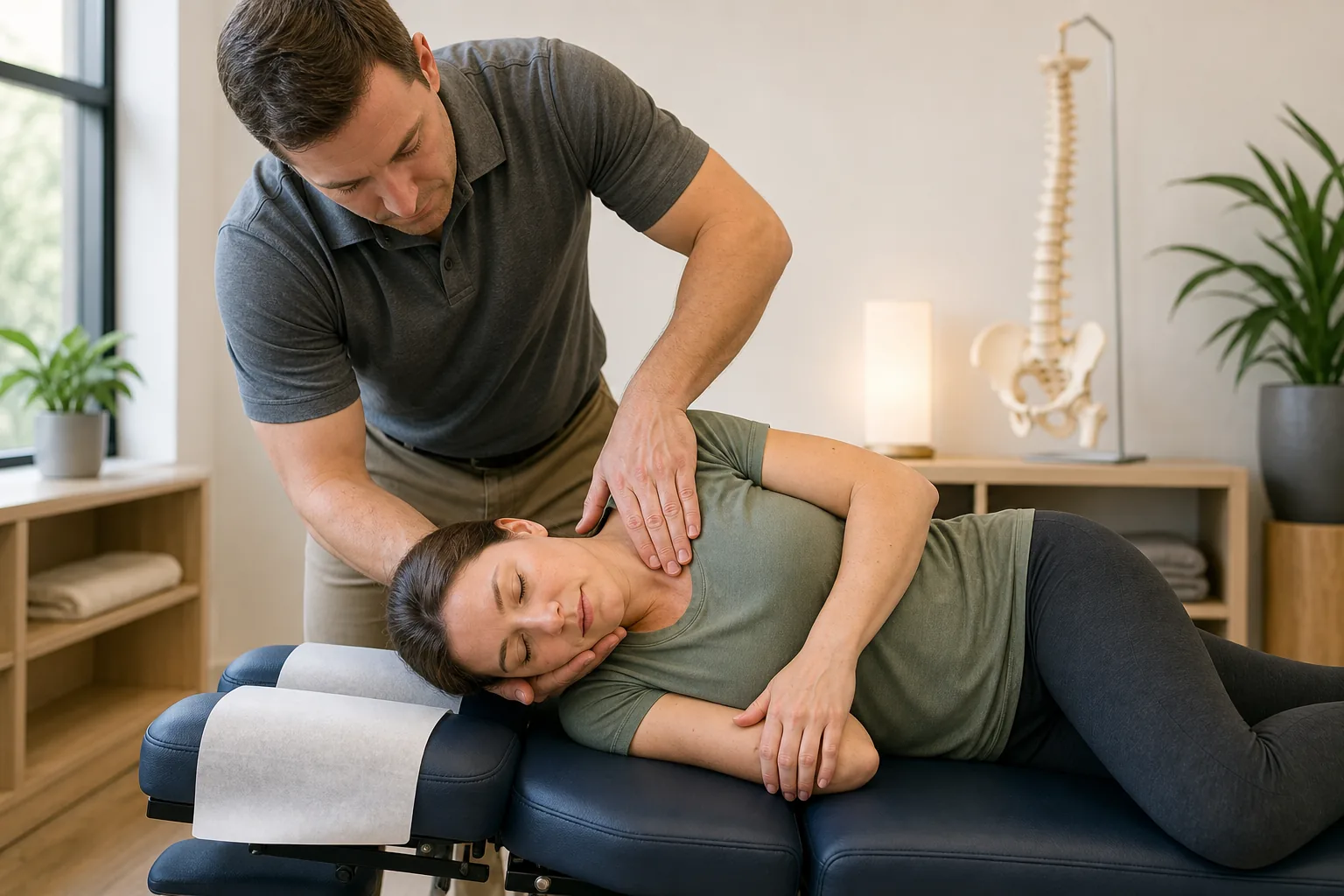
A practitioner may begin with history taking and a physical exam. They should check your neck range, strength, sensation and other signs before deciding whether mobilisation or an adjustment is suitable. Gentle techniques may be preferred when the neck is highly irritable.
Some presentations need referral instead. Arm weakness, pins and needles that persist, balance trouble, unexplained weight loss, fever or pain after significant trauma should not be treated as a routine stiff neck. A scan may be considered when the examination points to a structural or neurological issue.
Our view is simple: hands-on care should follow assessment, not replace it. The goal is to help you move more comfortably while addressing the habits that may have helped trigger the episode.
4. Muscle relaxants, short-term medical management of severe spasm
Muscle relaxants are prescription medicines that may be considered when a neck spasm is severe. They are a medical option, not a substitute for finding out why the neck has become fixed or painful.

A doctor may weigh the severity of the spasm against side effects, other medicines and your health history. Drowsiness can affect driving and work, so follow the prescriber’s directions closely. The research source for medication classes describes muscle relaxants by their muscle-relaxing action in its clinical reference on torticollis medicines.
These medicines may help you move enough to begin rehabilitation. They do not explain whether the episode is muscular, disc-related, joint-based or neurological.
5. Benzodiazepines, specialist-directed treatment for selected spasms
Benzodiazepines may be used under medical direction when anxiety or muscle spasm forms part of the problem. They are not a routine first choice for every stiff neck.

These medicines can cause sedation and may lead to dependence. Never share them, change the dose yourself or combine them with alcohol unless your doctor gives clear advice. A doctor may also look for a neurological cause if spasms keep returning or pull the head into a fixed pattern.
This option belongs within a wider plan. That may include a medical review, rehabilitation and treatment of the underlying condition rather than repeated medicine use alone.
6. Anticholinergics, options for specific neurological forms
Anticholinergics may be considered in selected neurological forms of torticollis. They work by counteracting acetylcholine, a neurotransmitter in the nervous system.
They are not designed for the usual one-off neck spasm after poor sleep. A neurologist or other medical specialist may consider them when involuntary contractions persist, repeat or pull the head in a recognisable pattern.
Side effects and interactions matter. The choice depends on age, other health conditions and the type of dystonia. Anticholinergics are one treatment option used in this specialist setting.
7. Botulinum toxin injection, targeted care for cervical dystonia
Botulinum toxin injections may help people with cervical dystonia , a neurological condition that causes repeated or sustained neck muscle contractions. They are not the usual answer for a simple stiff neck that began yesterday.

A specialist identifies the muscles causing the unwanted pull and injects the medicine into selected areas. The aim is to reduce excessive muscle activity so the head can sit and move more normally. Follow-up matters because the treatment plan may need adjustment.
This option has limits. It requires a clear diagnosis, specialist assessment and awareness of possible side effects. It also does not correct every cause of head tilt, such as a fixed structural problem or an untreated injury.
8. Vojta Therapy, structured rehabilitation for selected paediatric cases
Vojta Therapy is a structured rehabilitation approach that may be considered for selected children with developmental or congenital torticollis. It is not a general home exercise routine for adults with a sudden stiff neck.

Paediatric assessment should look at head position, muscle balance, movement control and development. A trained clinician may set a repeated programme for the child and teach parents how to support the plan safely.
Research on paediatric rehabilitation approaches includes retrospective cohort evidence for Vojta Therapy. That design can show patterns in treated groups, but it does not carry the same weight as a randomised trial. Progress should be checked over time rather than judged from one session.
9. NDT Bobath Concept, neuromuscular rehabilitation for developmental presentations
The NDT Bobath Concept is another rehabilitation approach used in selected developmental or neurological presentations. It focuses on movement quality, posture and control rather than simply stretching a tight neck.

A paediatric therapist may assess how the child turns, reaches, sits or balances. The treatment plan is then shaped around those movement needs. Parent education is important because daily handling and play can support the goals between visits.
It may be relevant when wry neck sits within a broader developmental issue, but it is not a replacement for medical review when symptoms appear suddenly.
10. Corrective surgery, reserved for fixed, severe or structural cases
Corrective surgery is reserved for severe, fixed or structural torticollis when conservative care has not resolved the problem. It is more relevant to selected congenital or long-standing cases than to a common overnight muscle spasm.

In children with congenital muscular torticollis, surgical options may be discussed after a sustained period of conservative treatment when the neck remains fixed. The operation may release or lengthen the sternocleidomastoid muscle. A specialist will explain the likely gains, risks and rehabilitation needs.
Medical assessment is important because a fixed head position can have several causes.
Presentation | Usual first direction | When escalation may be discussed |
Acute muscular or joint-based wry neck | Gentle movement, assessment and conservative care | Symptoms persist, recur or worsen |
Disc-related symptoms | Medical or allied-health assessment | Arm pain, numbness, weakness or persistent restriction |
Cervical dystonia | Neurological assessment | Repeated involuntary contractions |
Fixed congenital torticollis | Paediatric rehabilitation | Specialist review if conservative care fails |
Frequently asked questions
What is the fastest wry neck treatment?
The fastest safe treatment depends on the cause. A mild muscle spasm may settle with gentle movement, heat and rest from aggravating tasks. A clinician can help when pain is severe or the head is fixed. Avoid forcing stretches or high-velocity treatment before someone checks for disc, nerve, injury or neurological signs.
How long does wry neck take to heal?
Simple acute wry neck often improves over days, but recovery varies. Joint irritation may settle sooner than disc-related pain, while congenital or neurological forms need a longer plan. If symptoms are not easing, keep returning or interfere with sleep and work, arrange an assessment rather than relying on a fixed recovery promise.
Should I use heat or ice for a wry neck?
Heat may feel better when tight muscles and stiffness are the main issue, while ice can be useful after some fresh injuries. Neither is right for every case. Use a comfortable temperature for a short period, protect your skin and stop if symptoms worsen. An assessment can guide the choice.
Can I treat wry neck at home?
You can try gentle, pain-free movement at home when symptoms are mild and there are no warning signs. Keep your screen at eye level, avoid stomach sleeping and take breaks from long sitting. Do not dig hard into the front of the neck or force a locked movement. Seek care if progress is poor.
When should I see a doctor for wry neck?
See a doctor promptly for fever, severe headache, recent major trauma, weakness, numbness, trouble walking, swallowing problems or pain that travels into the arm. Children with a new fixed head tilt also need medical review. These signs can point beyond a routine muscular problem and should not wait for home care to work.
Conclusion
For a sudden, non-traumatic episode, start with a careful assessment and conservative care rather than forcing the neck or jumping to surgery. Unleashed Health Chiropractic can assess neck movement and discuss a non-surgical plan in Ascot Vale. If your symptoms include red flags, contact a medical service first. We understand that every neck problem is different, and we look forward to helping you choose a safe next step.


Comments