


Best Stretches for Lower Back Pain
Lower back stretches often focus on more than the back itself. Hamstrings, glutes and hip muscles can also affect how your pelvis and spine move. We’ll take you through a gentle routine, with clear hold times and safety checks for people in Ascot Vale and nearby Melbourne suburbs.
Table of Contents
Step 1: Check Whether Stretching Is Suitable Today
The best stretches for lower back pain are gentle, but they aren't right for every flare-up. First, work out whether your symptoms feel suitable for light movement today.
Stretching may suit mild stiffness that stays in your back. It may also help when your pain eases as you walk or change position. Start with a few minutes of easy walking around your home. Notice how your back responds.
Skip the routine for now if a stretch causes sharp pain, electric pain, tingling or pain that travels further down your leg. Be extra careful after a fall, lifting injury or sudden twist. New weakness also needs assessment before you test exercises.
Seek urgent medical care if back pain comes with new loss of bladder or bowel control, numbness around the genitals or anus, major leg weakness, fever or serious trauma. These signs need more than a home stretch routine. General information about back pain and its causes is available.
Use a firm but comfortable surface. Wear clothes that let your hips move. Keep a chair close if balance is uncertain. During every stretch, breathe normally and stay below the point of pain.
Key Takeaway:A mild stretch should settle when you stop. Sharp, spreading or worsening symptoms mean you should stop and seek advice.
By now, you should know whether gentle movement feels safe today. If it does, begin with small moving exercises rather than a long held stretch.
Step 2: Warm Up With Pelvic Tilts and Cat-Cow
Pelvic tilts and Cat-Cow warm the lower back without asking you to hold one deep position. They can help you find a comfortable range before you stretch further.
Pelvic tilt
Lie on your back with your knees bent and your feet flat. Let your back rest in its natural curve. Gently tip your pelvis so your lower back moves closer to the floor. Hold for a moment, then release.
Keep the movement small. Your pelvis should move more than your legs. Repeat slowly for several breaths. If lying down increases your pain, try the same motion while standing with your back near a wall.
Cat-Cow
Start on your hands and knees. Place your hands below your shoulders and your knees below your hips. Slowly round your back, then ease it into a gentle arch. Move through the middle rather than forcing either end.
Let your breath guide the pace. Try a few smooth repetitions. If your wrists hurt, place your hands on a firm bench. A folded towel under your knees can make the floor more comfortable.
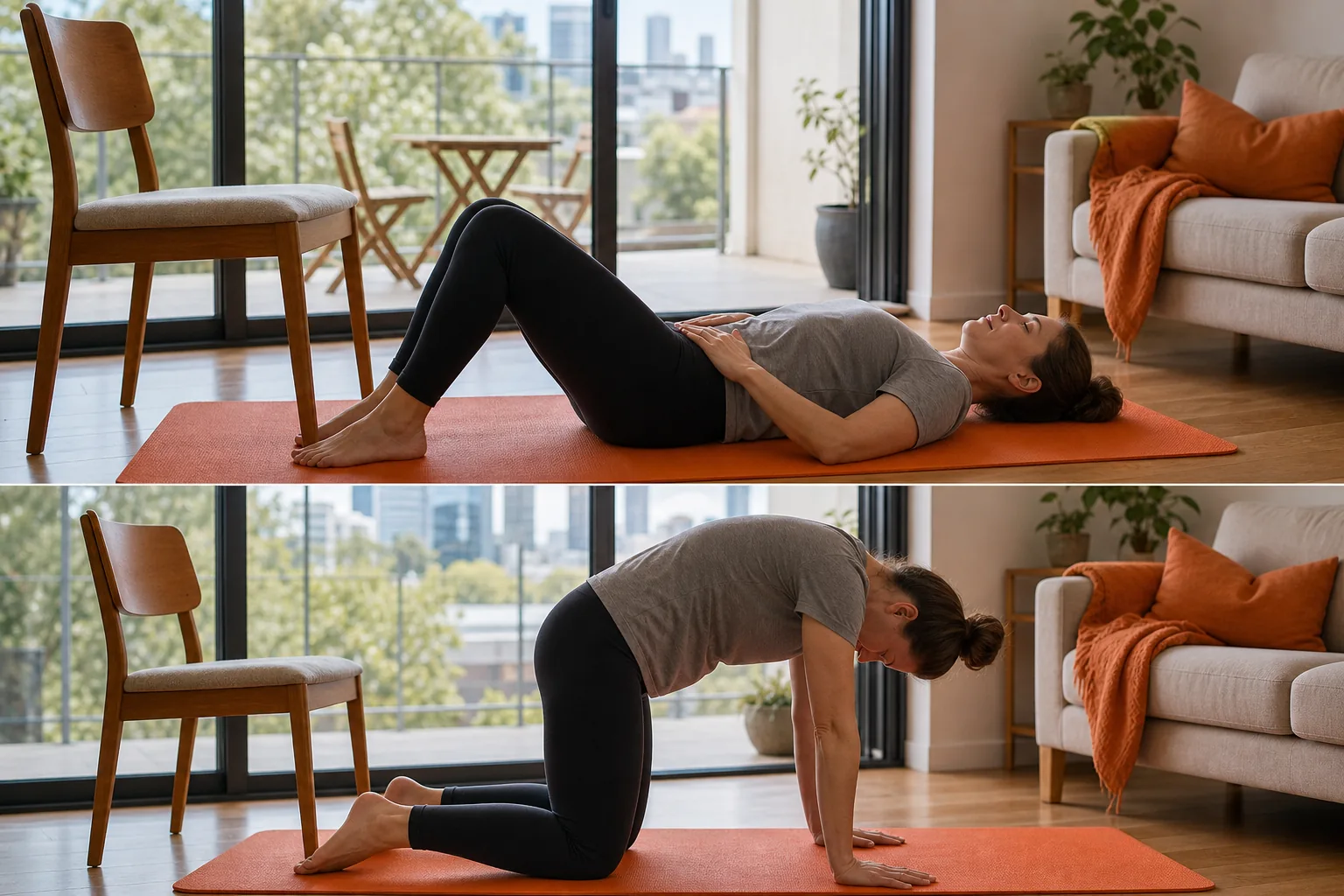
Our safe lower back exercises guide also uses small pelvic movements and a controlled cat-camel pattern. That approach is useful when a full range feels too much.
These movements are a warm-up, not a test. By now, you should feel more aware of your back's easy range. If you feel more guarded, reduce the movement or stop.
Step 3: Use Knee-to-Chest Stretches for Lower Back Tension
The knee-to-chest stretch can lengthen the lower back and reduce a feeling of tension for some people. It is often one of the easiest options to test because your body stays supported on the floor.
Lie on your back with both knees bent. Keep one foot on the floor. Hold behind the other thigh and guide that knee towards your chest. Don't pull on the kneecap. Keep the other leg relaxed.
Start with a 15 to 20 second hold. Rest for about 30 seconds, then repeat up to three times if your symptoms remain settled. You can switch sides between repetitions.
Some people prefer the double knee version. Bring both knees towards your chest and hold them behind the thighs. Use at least 30 seconds only if the position feels easy. Your hips and lower back should relax rather than fight the movement.
Don't force your knee higher to chase a stronger sensation. A mild pull through the lower back or buttock may be fine. Pinching at the front of the hip, sharp pain or symptoms into the leg is a clear reason to stop.
If this movement suits you, our guide on performing a piriformis stretch safely explains another supported hip position. The piriformis is a small muscle deep in the buttock.
By now, you should have one supported stretch that you can repeat without a symptom spike. Keep it in your routine only if you feel the same or better later that day.
Step 4: Gently Stretch Tight Hamstrings
Hamstrings sit at the back of your thighs. They connect with the pelvis, so tightness there can change how your lower back moves. Research gathered for this topic found that many commonly listed back stretches also target the hamstrings.
That hidden link matters. A routine that only targets the lumbar area may miss a muscle group that affects pelvic movement. Still, hamstring stretching must stay gentle, especially when your back or leg symptoms are irritable.
Supine hamstring stretch
Lie on your back with one knee bent. Hold behind the thigh and slowly straighten the leg until you feel a light pull behind it. Flex your foot towards you if that feels comfortable.
Hold for five seconds, then relax. Repeat five to 10 times. On the last repetition, you may hold for 30 seconds if your symptoms remain calm. Change sides and use the same range on both legs.
Seated option
Sit tall near the front of a firm chair. Extend one leg with the heel on the floor. Keep your back long and lean forward a small amount from your hips. Stop at the first mild pull behind the thigh.
A towel can help when reaching the foot is hard. Wrap it around the foot and hold both ends. Move your hands closer or further away to change the tension. Don't round hard through your back to reach your toes.
A standing hamstring stretch is another choice, but it demands more balance. Use a stable, non-rolling chair or a low step. Keep both knees soft and stop at a slight pull. Deep forward folds may aggravate some disc or nerve conditions.
Choose the version that lets you keep control. The stretch should feel local to the back of the thigh. If it feels electric or sends pain below the knee, stop and arrange an assessment.
By now, you should have tested one back-focused move and one hamstring-focused move. That pairing is often more useful than forcing a single deep back stretch.
Step 5: Add Glute, Trunk Rotation and Spinal Twist Movements
The next best stretches for lower back pain add the glutes and gentle rotation. These movements can help when your back feels stiff after sitting, but they should stay within a smooth range.
Supine glute stretch
Lie on your back with both knees bent. Place your right ankle over your left knee. Hold behind the left thigh and draw both legs towards you until you feel a stretch in the right buttock.
Keep the right foot flexed towards your shin. Hold for five seconds and release. Repeat five to 10 times, then hold the last repetition for 30 seconds if comfortable. Change sides.
Trunk rotation
Stay on your back with your knees bent and your feet flat. Let both knees move a small distance to one side while your shoulders stay on the floor. Return to the middle, then change sides.
Move slowly. You don't need to push your knees towards the floor. The aim is easy motion through the trunk. You should not feel a sharp catch in the back or hip.
Supine spinal twist
Lie on your back and stack one leg over the other. Let both legs drop to one side while your shoulders stay heavy on the floor. Hold for 10 seconds and return to centre. Repeat five times on each side.
As control improves, you may hold for 30 seconds. Keep the range even on both sides. A twist that causes leg pain is not the right choice today.
Pro Tip:Judge a stretch twice. Check how it feels during the movement, then check again ten minutes later. A useful exercise should settle, not leave you much worse.
These movements target the lower back, gluteals and trunk rather than treating one spot in isolation. That wider view fits the way many people move at a desk, in a car or while lifting at home.
Step 6: Build a Comfortable Routine and Know When to Get Help
A short routine done often is usually easier to manage than one long session. Build it around the movements that leave you feeling steady later.
Start with five minutes of easy walking. Then use pelvic tilts or Cat-Cow for a few slow repetitions. Add one knee-to-chest stretch. Finish with either a hamstring stretch, glute stretch or gentle rotation.
Hold static stretches for five seconds at first. If that feels settled, build towards 15 to 30 seconds. The research reviewed for this topic found that dosage details are missing for most commonly listed stretches, so don't treat one number as right for everyone.
Try this simple plan:
On a stiff morning, walk first and use only small movements.
After long sitting, use Cat-Cow or a seated hamstring stretch.
On a settled day, add one glute or rotation movement.
If symptoms rise, return to the last level that felt manageable.
Change one feature at a time. First add a little walking time. Then test a slightly larger range. Once that feels steady, add another repetition or stretch.
Keep a simple note of your symptoms before movement, during movement and later that day. This helps you spot patterns. It also gives a chiropractor or other health professional useful detail if you need an assessment.
We understand that everyone responds differently. At Unleashed Health Chiropractic , we take the time to assess how your back, hips and legs work together. We tailor advice to your symptoms rather than handing you a fixed list of stretches.
Arrange professional care when pain keeps returning, affects sleep or work, or limits walking and normal tasks. You should also seek help when pain travels down a leg, or when numbness or weakness develops. Professional assessment can help guide management of low back pain.
Go to an emergency department for new bladder or bowel changes, saddle numbness, major weakness, fever or significant trauma. For non-urgent back pain in Ascot Vale, Unleashed Health Chiropractic can help you decide whether stretching, strengthening or another form of care suits your situation.
Key Takeaway:Keep the stretches that help you move with less guarding. Drop any move that spreads symptoms or leaves you worse for hours.
FAQ
What are the best stretches for lower back pain?
The best stretches for lower back pain are usually the ones that reduce stiffness without spreading symptoms. Gentle knee-to-chest, pelvic tilts, Cat-Cow, hamstring stretches and supported glute movements are common options. Your response matters more than the name of the stretch. Stop if you feel sharp, electric or radiating pain.
Should I stretch my hamstrings for lower back pain?
Yes, hamstring stretching may help when tight muscles affect pelvic movement. Use a supported lying or seated version first. Keep the pull mild and avoid rounding hard through your back. If the stretch causes pain below the knee, tingling or more leg pain, stop and seek an assessment.
How long should I hold a lower back stretch?
Start with about five seconds if your back is sensitive, then build towards 15 to 30 seconds when the movement stays comfortable. Some listed exercises use different timings, so there is no single hold that suits everyone. Repeat gently rather than forcing a long position.
Can stretching make lower back pain worse?
Yes, stretching can make lower back pain worse when the range is too deep or the movement irritates a nerve. Avoid bouncing or forcing a toe touch. Reduce the range if symptoms rise. Stop when pain becomes sharp, travels down the leg or remains worse after the session.
When should I see a chiropractor for lower back pain?
You should see a chiropractor when back pain keeps returning, limits daily tasks or does not settle with sensible movement. Seek urgent care for bladder or bowel changes, saddle numbness, major weakness, fever or serious injury. Unleashed Health Chiropractic can assess your movement and discuss a tailored care plan.
Conclusion
Start with walking, pelvic tilts and one supported stretch. Keep the range easy and track how you feel later that day. If your pain persists or travels into your leg, arrange an assessment with Unleashed Health Chiropractic in Ascot Vale so we can help you choose the next safe step.


Comments