


5 Posture Exercises for Office Workers
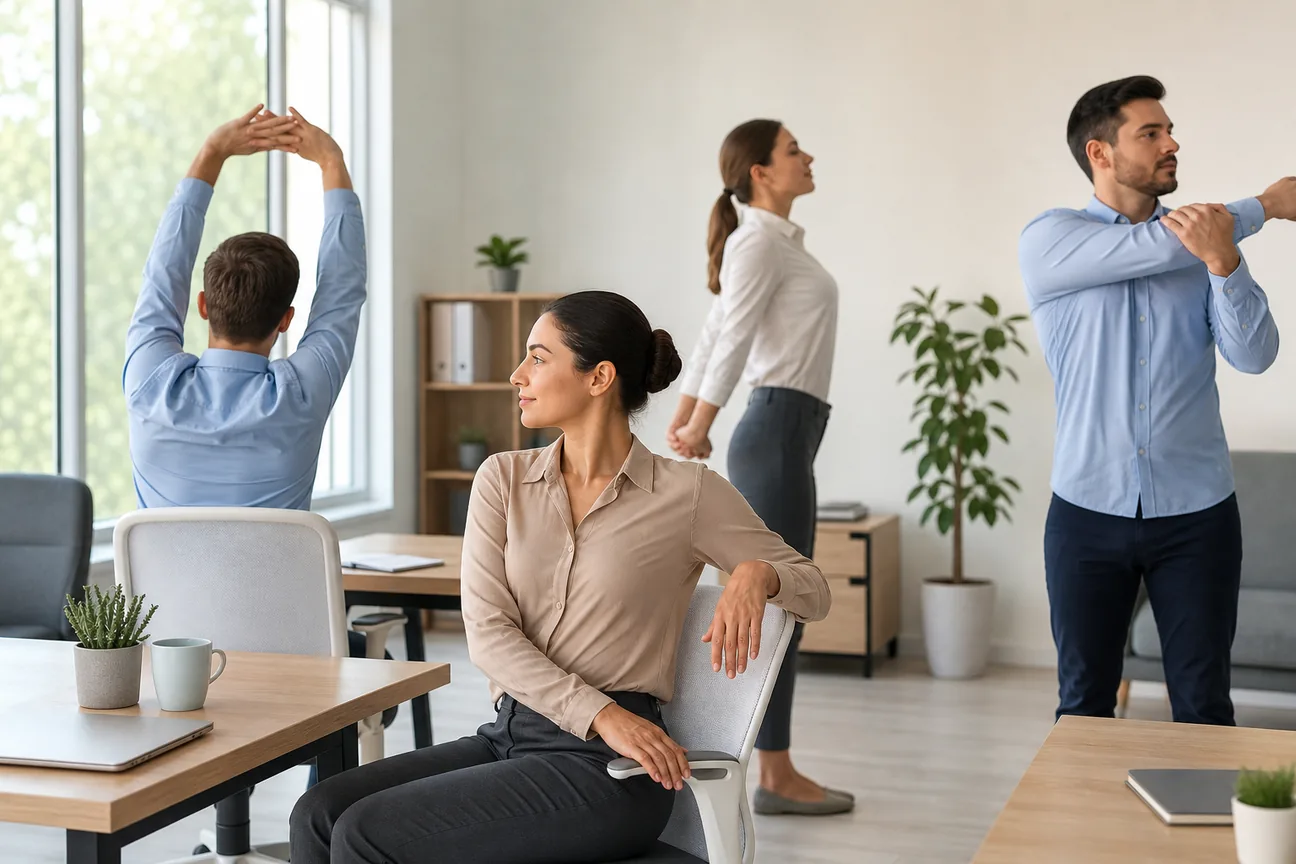
By mid-afternoon, hours at a desk can leave your neck and shoulders feeling stiff. These five posture exercises for office workers use simple movements and little or no equipment, so you can try them during a workday break.
We’re sharing them as general movement ideas, not a personal treatment plan. Start gently, and stop if a movement causes pain or makes you feel unwell.
Table of Contents
1. Doorway Pectoral Stretch: a desk break for the chest and shoulders
This stretch uses a doorway or wall to place your arm while you gently turn your body away. It may suit you if you’ve been sitting with your arms in front of you and want a brief change of position.
Stand beside an open doorway. Rest one forearm on the frame with your elbow below shoulder height. Take a small step forward, then turn your chest away until you feel a mild stretch across the front of your shoulder or chest. Keep the sensation gentle, not sharp.
Hold for 10 to 20 seconds while breathing normally.
Repeat once on the other side.
Keep your shoulder relaxed. Don’t twist or lean hard to make the stretch stronger.
The time is a suggested starting point, not a dose that suits everyone. If you feel pain, pins and needles, or a strong pulling feeling, ease out of the position. A wall can work if there isn’t a clear doorway, but use a stable spot with room to move.
If your chair setup is part of what you want to review, our guide to office chair posture and sitting well covers desk setup and movement breaks. A stretch can be a useful pause, but it doesn’t replace a workstation that lets you sit comfortably.
2. Chin Tucks: a gentle movement for the neck
Chin tucks are small neck movements you can do seated, with no equipment. They may suit a short screen break when you notice your head has crept forward. Think of your head sliding back, not tipping down.
Sit with your back supported and look straight ahead. Without looking down, draw your chin gently back, as if making a small double chin. Keep your jaw loose. Pause briefly, then let your head return to its usual position.
Try 5 slow repetitions.
Hold each one for about 2 to 3 seconds.
Keep the movement small and smooth. Don’t force your head back.
These counts are a simple starting suggestion, not a treatment prescription. If you get dizziness, pain, tingling or a headache during the movement, stop. If neck symptoms persist or keep returning, a GP or another qualified health practitioner can help assess what may be contributing.
A brief neck movement break can fit into a workplace posture routine. For more neck movement ideas, see our forward-head posture exercise guide .
3. Scapular Retractions: an easy upper-back movement between tasks
Scapular retractions are gentle shoulder-blade movements you can do while seated or standing. They may suit a moment between tasks when you want to move your upper back without leaving your desk.
Sit or stand tall without stiffening. Let your arms rest by your sides. Slowly draw your shoulder blades towards each other, as though they’re moving towards the back pockets of your trousers. Keep your shoulders low, hold for a moment, then relax fully.
Try 8 slow repetitions.
Hold each squeeze for 2 to 3 seconds.
Keep your ribs relaxed. Avoid arching your lower back or shrugging.
The movement should feel controlled and comfortable. Don’t squeeze as hard as you can. If one side feels different, reduce the range rather than forcing both shoulders into the same position.
You could pair a few repetitions with a slow breath out, then return to your task. The breathing is simply a cue to slow down, not a promise of a health effect. A brief movement break can help you change position during a long stretch of sitting; it doesn’t need to become a workout.
4. Wall Angels: a standing option for shoulders and upper back
Wall angels use a wall as a guide while you move your arms up and down. They may suit you if you’d like a standing break and have a clear section of wall nearby.
Stand with your back near the wall and feet a short step forward. Let your arms rest by your sides. Bend your elbows, then slowly slide your arms up only as far as feels comfortable. Bring them back down with control. Your arms don’t need to stay in contact with the wall throughout.
Try 5 slow repetitions.
Move within a comfortable range rather than reaching high.
Keep breathing. Don’t force your back flat against the wall.
Some people find this movement hard to do without arching their back or tensing their neck. If that happens, make the range smaller or skip it. The wall is a guide, not a test of flexibility.
For a quick desk reset, you can stand up, do a few easy repetitions and sit back down when ready. If shoulder movement is uncomfortable, don’t push through it just to finish the exercise.
5. Rows: a simple upper-back movement for a desk break
Rows usually use resistance, but you can try a no-equipment version by drawing your elbows back while keeping your hands relaxed. It may suit you when you want to move your upper back without leaving your chair.
Sit upright with your feet supported. Bend your elbows and bring them gently back towards your sides, as if pulling two light handles. Pause briefly, then return your arms to the starting position. Keep your shoulders relaxed and avoid pushing your chest forward.
Try 8 slow repetitions.
Pause for 1 to 2 seconds as your elbows move back.
Use a small range if your shoulders or back feel tight.
This version has no external resistance, so treat it as a movement cue rather than a strength workout. Stop if it brings on pain, tingling or weakness. For another desk-related movement resource, our guide to managing back pain from a desk job discusses breaks and everyday setup considerations.
Workstation comfort matters too. Adjust your chair so your feet can rest on the floor or a stable footrest. Place the screen at a height that lets you look ahead without repeatedly bending your neck, then keep the keyboard and mouse close enough to use without reaching. Small changes may make it easier to vary your position during the day.
Fit the movements into a workday
You don’t need to do all five exercises in one go. Choose one or two that feel comfortable, and try them after a meeting or when you get up for water. A short walk can also break up a long spell at your desk. A general activity tracker is another option to consider.
Keep the routine easy to repeat. You might set a reminder for one natural pause in your day, then note which movement felt comfortable. If you’re tracking, write down the exercise and how it felt, not a score for how straight you sat. Posture changes through the day, and one position isn’t meant to be held perfectly.
Unleashed Health Chiropractic is based in Ascot Vale and provides a postural assessment as part of its initial appointment. An assessment can help work out whether individual advice is suitable for your needs. We take the time to assess each person, because the same movement may not suit everyone.
Get medical advice if pain keeps returning or affects daily activities. Seek prompt care for new weakness or numbness. Sudden severe symptoms, chest pain or a sudden severe headache need urgent medical attention. Don’t use desk exercises to delay care for a concerning symptom.
Frequently asked questions
How often should I do posture exercises at my desk?
There isn’t one schedule that suits everyone. You could try a few comfortable repetitions during a natural pause, such as after a meeting or when you stand to get water. Change position through the day rather than aiming to hold one “perfect” posture. If a movement causes pain or other symptoms, stop and seek individual advice.
Can I do these exercises while sitting?
Yes, chin tucks, scapular retractions and the no-equipment row can be done seated. Sit with your feet supported and use a small, comfortable range. The doorway stretch and wall angels need a suitable space to stand. You can leave out any movement that doesn’t feel right for you.
How many repetitions should I start with?
For this routine, try 5 repetitions for chin tucks or wall angels, and 8 for scapular retractions or rows. Hold a doorway stretch for 10 to 20 seconds on each side. These are modest starting suggestions, not evidence-based doses or personal medical advice. Use fewer repetitions if needed, and stop if symptoms worsen.
What should I do if an exercise hurts?
Stop that movement and return to a comfortable position. Don’t push through sharp pain, tingling or a feeling of weakness. If discomfort continues, comes back often or affects your daily activities, speak with a GP or another qualified health practitioner. Seek urgent medical care for sudden severe symptoms or new neurological signs.
A simple next step
Pick one movement that feels comfortable and pair it with a regular pause from sitting. If you’d like advice tailored to your symptoms, you can learn about an assessment at Unleashed Health Chiropractic in Ascot Vale and discuss whether it suits your needs.


Comments