


Anterior Pelvic Tilt: Causes, Symptoms and Exercises
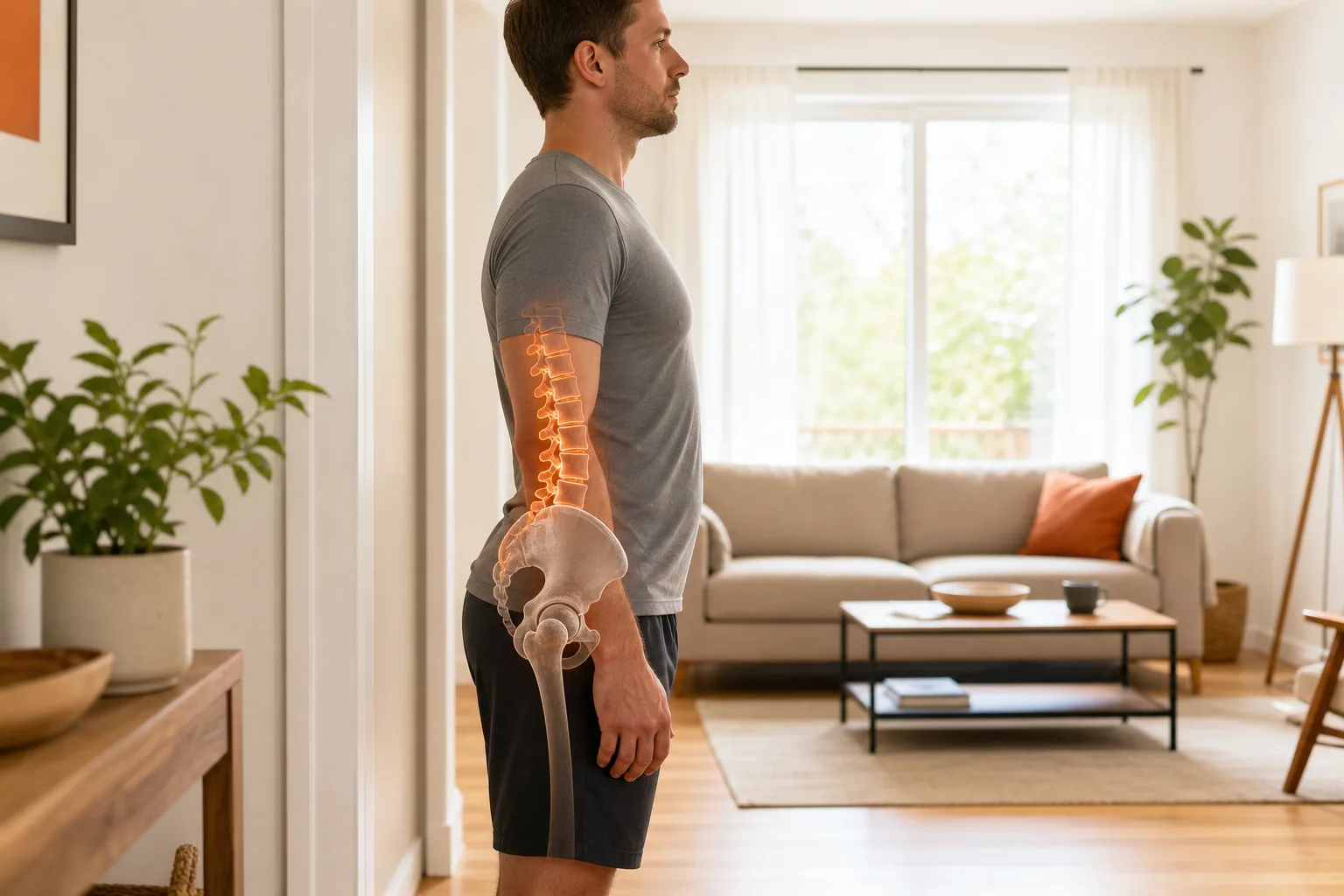
A forward-tilted pelvis can be a normal part of how your body stands. It may be worth looking at more closely if you also have pain or find movement difficult. Here’s what the tilt means, what a simple self-check can tell you, and how to try gentle strength and mobility work.
Table of Contents
What Is Anterior Pelvic Tilt?
Your pelvis sits between your lower spine and your thigh bones. In an anterior pelvic tilt, it rotates forward: the front points down, while the back rises. That position can make the curve in your lower back look more pronounced.
A small forward tilt is part of normal posture. Bodies vary, so seeing an arch in your lower back does not by itself mean there’s a problem. The question is whether the position is linked to discomfort, limited movement or difficulty controlling your pelvis during everyday tasks.
Pelvic position can change when you stand, walk, bend or exercise. It isn’t a fixed shape that tells the whole story about your health. Muscle activity, pain, bone shape and the movement of nearby joints may all affect how your pelvis rests. Researchers have also found wide variation in pelvic tilt among people without symptoms.
Some online advice treats a visible arch as a condition that always needs correction. That’s too simple. A posture check can’t tell you why a particular person has pain, or whether their pelvic position is the cause. If your back or hip is sore, it’s worth assessing the symptoms as well as the posture.
At Unleashed Health Chiropractic in Ascot Vale, an initial appointment includes a medical history and physical, neurological, orthopaedic and chiropractic examinations, as well as a postural assessment. Spinal X-rays covered by Medicare may be considered if clinically indicated. You can read more about pelvic pain and what a chiropractic assessment involves .
Common Contributors: Sitting, Activity and Muscle Balance
Long periods of sitting and low levels of activity may contribute to changes in posture and muscle use. A seated workday can mean your hips stay bent for hours, with few chances to change position. But sitting alone doesn’t prove that your pelvis is tilted or that it’s causing pain.
Some descriptions of this posture focus on a balance between muscle groups. Hip flexors at the front of the hip help lift your thigh. Gluteal muscles and hamstrings help extend your hip. The abdominal muscles help control your trunk and pelvis. If some muscles feel stiff or are less used, your movement habits may change. That pattern is sometimes called lower crossed syndrome , but it’s a label for a proposed muscle pattern, not a diagnosis made from appearance alone.
It’s common to hear that tight hip flexors and weak glutes or abdominals explain every case. In real life, the picture can be less neat. A person can be flexible and still prefer an arched posture. Someone who lifts weights may have strong legs but find it hard to control their pelvis in a particular movement. One exercise plan won’t suit everyone.
A peer-reviewed clinical review notes that muscle tone, pain, bone shape and movement in nearby areas can all influence pelvic position. It also points to variation among people without symptoms. That’s one reason visual posture alone can’t identify the cause of a sore back or hip. The review of pelvic tilt assessment and clinical use discusses these limits.
Genetics may influence body shape, and bone structure differs between people. Neither fact means a person is stuck with pain or can’t learn new movement skills. Nor does a posture difference prove that genetics caused it. Instead of trying to force a single “perfect” stance, notice what happens when you walk, stand up from a chair or climb stairs.
Activity matters in a broader way than simply stretching more. If your day involves lots of sitting, standing up and walking briefly can add movement. If you already train often, review whether your routine includes comfortable hip movement and gradual strength work. A sudden jump in exercise volume may irritate symptoms, so change one thing at a time.
Possible Symptoms and When to Seek Advice
Many people with a forward-tilted pelvis have no symptoms. Others report discomfort in the lower back, hip or knee. The presence of pain doesn’t show that pelvic position caused it. Pain can have several possible sources, and the relationship between posture and symptoms isn’t always clear.
Notice the details that help describe your problem. Does it begin after sitting for a long time, during a run or when you lift something? Does it ease when you change position? Is it on one side or both? These observations can help a health professional understand what you’re experiencing, but they can’t confirm a diagnosis on their own.
If discomfort lasts, worsens or affects normal activities, speak with a GP or another suitable health professional. Seek prompt medical advice if pain follows a significant fall or injury, or comes with fever or feeling unwell. Get urgent care for sudden severe pain, new weakness or numbness, numbness around the groin, or new problems controlling your bladder or bowel. Don’t rely on posture exercises to assess or manage those symptoms.
Children and young people with a noticeable or changing posture difference should be assessed by a health professional, especially if they have pain or trouble moving. An adult should also seek advice if a tilt seems to be progressing or if one side feels markedly different. A clinician can consider the whole picture rather than judging a single photograph or test.
Unleashed Health Chiropractic provides care for back pain and rehabilitation in Ascot Vale. An assessment can help clarify whether the clinic’s approach suits your needs. It shouldn’t replace a GP’s assessment when symptoms call for medical care.
Simple Self-Assessment: What You Can and Can’t Tell
A home check can help you notice how your body moves. It can’t diagnose a pelvic problem. Skin, body shape and the location of bony landmarks can make visual estimates imprecise, and a still image shows only one position.
Try a relaxed standing check
Stand side-on near a mirror, with your feet resting comfortably and your knees soft. Don’t pull your shoulders back or force your stomach in. Notice whether you can gently rock your pelvis forward and back, then return to a position that feels easy to hold.
Look for comfort and control, not a ruler-straight line. You may have a natural curve in your lower back. If holding a different position makes you brace, bend your knees or feel pain, stop rather than pushing through. A side-view photo can help you compare your own stance over time, but it can’t confirm a diagnosis.
Try a gentle lying check
Lie on your back with knees bent and feet flat. Let your lower back rest in its usual position. Then gently tighten your abdomen and buttocks so your lower back moves closer to the floor. Notice whether you can make that small movement without holding your breath or straining.
This is a movement check, not a pass-or-fail test. The gap between your back and the floor varies with body shape. Being unable to flatten your back completely doesn’t prove you have a problem. If the movement causes pain, stop and ask a health professional what may be suitable.
What about the Thomas test or an inclinometer?
The Thomas test is often used to look at hip movement and the flexibility of muscles at the front of the hip. It involves lying near the edge of a firm surface while bringing one knee towards your chest and letting the other leg rest. The position of the resting leg may offer a clue, but it doesn’t establish a diagnosis by itself. It can also be difficult to set up safely at home.
Some clinicians use a hand-held inclinometer, a tool that measures an angle, or other methods to estimate pelvic position. These measures depend on finding landmarks accurately and using the tool in a consistent way. A reading is one part of an assessment, not a verdict about pain.
An X-ray isn’t a routine home test for posture. Imaging decisions depend on the clinical question and your circumstances. At Unleashed Health Chiropractic, spinal X-rays covered by Medicare are considered only if clinically indicated. A self-check should never be used to decide that imaging is needed.
Asymmetry is another point that can cause worry. One side of your pelvis may look or feel different from the other, but that does not tell you why. Compare how each side moves during a simple task, such as stepping down, and note any pain or loss of control. Avoid trying to push the sides into matching positions. A clinician can assess whether the difference matters for your symptoms.
Exercises to Build Strength and Mobility
Exercise ideas often focus on hip mobility and strength in the buttocks, hamstrings and abdomen. These moves may be useful for general movement practice, but no single routine is right for everyone. Start with a comfortable range. Stop if you feel sharp pain, spreading symptoms, dizziness or a new sense of weakness.
Half-kneeling hip-flexor stretch
Kneel on a folded towel, with one foot forward and the other knee on the floor. Hold a wall or sturdy chair if you need balance. Gently tuck your pelvis and shift your body forward a little, keeping your chest relaxed. Aim for a mild pull at the front of the hip on the kneeling side.
Don’t push your hips far forward or arch your lower back to make the stretch feel stronger. If kneeling is uncomfortable, try a short split stance while standing and hold a firm support. Our guide to safe hip-flexor stretch options describes ways to adjust the position.
Glute bridge
Lie on your back with knees bent and feet flat. Gently engage your abdomen, then lift your hips only as far as you can without arching your lower back. Pause briefly and lower with control. You should feel the work around your buttocks and the backs of your thighs, not a pinch in your back.
Begin with a few smooth repetitions. If that feels manageable, add a few more over time or pause slightly longer at the top. If you can’t keep your hips level, make the lift smaller. A single-leg version is a later challenge, not a test you need to pass.
Squat to a chair
Stand in front of a sturdy chair with feet about hip-width apart. Send your hips back as if you’re about to sit, then stand up at a pace you can control. Keep your feet steady and your knees tracking in line with them. Use your hands on the chair or a nearby support if balance is a concern.
There’s no need to force your knees to stay behind your toes. Aim for a range that feels steady and comfortable. If you’re sore, start with a smaller bend or skip the move until you’ve had advice. The goal is controlled motion, not a deep squat.
Plank variation
Start on your hands and knees, with your hands under your shoulders. Tighten your abdomen gently without holding your breath. If comfortable, step one foot back, then the other, or keep your knees down for an easier version. Hold only while you can breathe normally and keep your back comfortable.
A plank works the trunk muscles, but it won’t automatically change pelvic position. If your lower back sags or feels strained, shorten the hold or return to the easier version. Quality matters more than time.
Supported reverse lunge
Stand beside a wall or stable chair. Step one foot back a short distance and bend both knees a little, keeping your trunk upright. Push through the front foot to return to standing. Use a small range at first and hold the support throughout if needed.
Choose one or two moves to start. A short, repeatable routine is easier to adjust than a long session that leaves you sore. Try it on alternate days at first if you’re unsure how your body will respond. If you feel settled during and after the movement, you can gradually add repetitions or a little more range. If symptoms flare, reduce the effort or pause and ask for guidance.
There isn’t one proven dose for everyone. General exercise suggestions online may not fit your health, fitness or pain history. Unleashed Health Chiropractic lists rehabilitation exercises among its chiropractic services, but an exercise plan should be matched to an individual assessment rather than assumed from posture alone.
Breathing, Abdominal Engagement and Exercise Progression
Breathing can help you notice whether you’re bracing too hard. During a bridge or squat, breathe out as you make the effort. Let your ribs soften rather than lifting your chest and arching your back. Keep breathing as you move; don’t hold your breath to make your trunk feel firm.
Think of abdominal engagement as a light brace, not a hard suck-in. You should still be able to speak a short sentence. The side abdominal muscles help control trunk movement, but you don’t need to force a special contraction or press your back flat throughout the day. Practise a gentle brace, then let it go.
Progression can mean doing one more comfortable repetition, using a slightly longer hold or choosing a small increase in range. Change one part at a time. For example, if a bridge feels steady for several sessions, add a few repetitions before trying a harder version. There’s no need to add weight unless you can keep the movement controlled and have a reason to do so.
Frequency is individual. A brief practice on several days may be easier to tolerate than one demanding session, but daily exercise isn’t a rule for everyone. Track how you feel during the activity and later that day. If soreness settles quickly and doesn’t affect normal tasks, you may be ready to keep going. If pain builds or lasts, scale back and seek advice.
Different muscles may feel different from side to side. Don’t add extra work to one side just because it looks less even in a mirror. Use a comfortable, similar effort on both sides unless a clinician has assessed a reason to change that plan.
Everyday Habits for a Comfortable, Flexible Posture
You don’t need to hold one ideal posture all day. Most people shift positions without thinking, and it’s reasonable to change yours when you feel stiff or tired. If you sit for long stretches, stand up or walk briefly when you can. The aim is more variety, not perfect posture.
At a desk, set your chair and screen so you can work without reaching far or holding your shoulders tense. Keep your feet supported if that feels comfortable. Then change position from time to time. A small adjustment to your seat can help you feel more at ease, but no chair setting can guarantee a particular pelvic position.
Notice how your body responds to daily tasks. When you lift a light object, bring it closer before you stand. When you walk, let your arms move and avoid deliberately tucking your pelvis with every step. In exercise, use a range you can control rather than copying someone else’s stance.
Short movement breaks can be simple: walk to get a drink, stand while reading a note or gently shift your weight from one foot to the other. These are options, not a treatment dose. Choose a pattern that fits your day and doesn’t increase pain.
Posture can also look different when you’re tired or focused on a screen. That doesn’t mean you’ve undone your progress. If a position feels uncomfortable, change it. If discomfort persists, ask a health professional to assess the issue rather than trying to correct your posture by force.
For more ideas on movement and back comfort, see our advice on posture exercises for people with back pain . Use any exercise that suits your symptoms and stop if it makes them worse.
Frequently Asked Questions
How can I tell if I have an anterior pelvic tilt?
You can notice how your pelvis moves with a simple standing or lying check, but you can’t diagnose yourself from appearance alone. A visible lower-back curve is common and can vary with body shape. If you have pain or movement limits, a health professional can assess your symptoms alongside posture and movement.
Can sitting cause a forward pelvic tilt?
Long periods of sitting may contribute to changes in how you use your hips and trunk, but sitting doesn’t prove that it caused a tilt or pain. Try changing position and adding brief movement breaks when your day allows. If symptoms continue, seek an assessment rather than assuming your chair is the cause.
Which exercises may help with pelvic control?
Gentle hip-flexor stretching, bridges, supported squats and plank variations are common ways to practise mobility or strength. They may suit some people, but the right choice depends on your symptoms and ability. Start with an easy version, keep breathing and stop if pain sharpens or spreads.
Do I need an X-ray to check my pelvic position?
An X-ray isn’t a routine self-check for posture. Imaging decisions depend on your symptoms and the clinical question. A clinician can assess you and decide whether imaging is indicated. Don’t arrange an X-ray solely because a mirror or online test suggests that your pelvis looks tilted.
When should I see a doctor about back or hip pain?
See a GP if pain persists, gets worse or limits everyday activities. Seek urgent medical care for sudden severe pain, new weakness or numbness, numbness around the groin, or new bladder or bowel control problems. After a significant injury, get prompt medical advice. These symptoms need medical assessment, not a posture routine.
Conclusion
A forward pelvic position doesn’t automatically need correcting. If you have discomfort or want help understanding your movement, arrange an assessment with a suitable health professional. Unleashed Health Chiropractic in Ascot Vale can assess your needs and discuss whether its care is appropriate. For severe or sudden symptoms, seek medical care promptly.


Comments